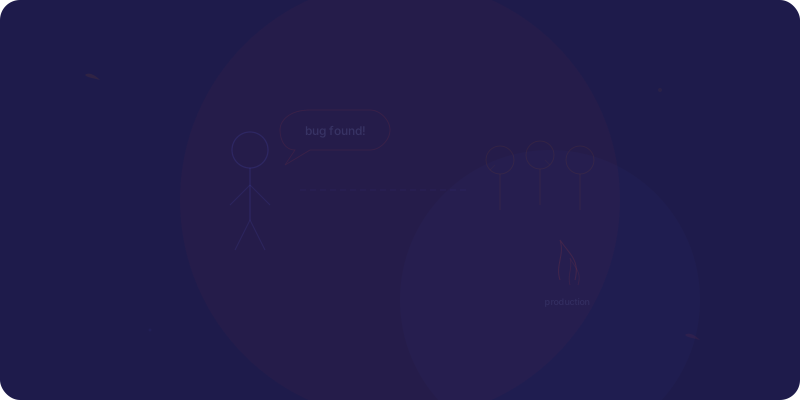
The standup is exceeding its timebox. A QA engineer reports that the new checkout flow contains a race condition: if the user double-clicks the submit button with sufficient speed, the order is created twice. The product manager glances at the sprint board. The technical lead checks a notification. Someone states “we can address that after launch.” The QA engineer acknowledges the response, documents the finding, and moves on. Two weeks later, the first duplicate charge occurs. Then the second. Then thirty. The communication channel that was too occupied to process the warning now contains an incident thread with 47 messages.
This pattern is replicated across engineering organizations on a daily basis. The individual whose designated function is to identify problems before customers encounter them is systematically deprioritized, overruled, and disregarded, then held accountable when the problems they documented reach production. This is not a matter of intent. It is structural. And it is generating costs that most organizations have not attempted to quantify.
The Organizational Hierarchy of Visibility
In most technology organizations, an implicit hierarchy governs perceived contribution value. Engineers who build features occupy the highest tier. Their work generates visible value: it is demonstrated to stakeholders, announced in release communications, and recognized in organizational forums. Product managers occupy the next tier, defining what is built. Designers follow, determining how it presents and functions.
QA engineers are positioned near the lower end of this hierarchy. Their work is, by definition, oriented toward identifying what is defective rather than constructing what is new. Defect reports do not generate organizational enthusiasm. Test plans are not demonstrated to executive leadership. No one receives a promotion for preventing a disaster that never materialized, because prevented disasters are organizationally invisible. Research indicates that preventive contributions are valued at 60% less than constructive contributions in standard performance review frameworks.
This hierarchy manifests across multiple organizational dimensions. QA is the last function to receive headcount and the first to be reduced during workforce adjustments. QA compensation is typically 20-30% below developer compensation, despite comparable skill requirements. QA perspectives are “noted” in planning sessions but rarely modify the plan. QA concerns are logged but rarely block a release. The hierarchy is not formally documented, but it is universally understood within the organization.
Accountability Asymmetry in Quality Outcomes
The most problematic structural element of the QA role is the asymmetry in accountability. When a QA engineer identifies a defect prior to release, the event generates no organizational signal. The defect is resolved, the release ships, and credit accrues to the team collectively. When a defect reaches production, the organizational response is: “How did QA miss this?”
The question is never “Why did the engineer introduce this defect?” or “Why did the product manager reduce the testing window from five days to two?” or “Why did the technical lead override the QA engineer who flagged this precise issue three weeks prior?” The question is consistently directed at the individual with the least organizational authority: the tester.
This accountability asymmetry produces a corrosive behavioral effect. QA engineers learn that they receive no recognition for identifying defects and full accountability for missing them. The rational response to this incentive structure is to over-report, over-document, and over-communicate, creating an audit trail that demonstrates the issue was flagged, regardless of whether anyone acted on it. This produces a culture of defensive testing, where the objective shifts from improving the product to establishing a record of due diligence.
The “Shift Left” Implementation Failure
The industry has embraced the phrase “shift left,” referring to the principle that testing should occur earlier in the development lifecycle, ideally by engineers themselves. In theory, this is sound. Identifying defects earlier is invariably less expensive. In practice, “shift left” frequently signifies something materially different: “the QA function is being eliminated and the decision is being framed as a process improvement.”
The typical implementation proceeds as follows: Engineers are informed they are now responsible for testing their own code. QA headcount is reduced or eliminated. The engineers, who were already at capacity building features, now carry an additional responsibility with no additional time allocation. They write unit tests covering the primary success path and consider the task complete. Data from organizations that implemented shift-left without QA retention shows a 25% increase in production defect rates within two quarters.
The exploratory testing that QA engineers performed, the creative, adversarial, “what occurs if a user does this unexpected thing?” testing, ceases entirely. No one performs it. Not because engineers are incapable, but because they lack the time, the cognitive orientation, and the incentive structure. The individual who constructs something is the least effective person to attempt to break it. They understand precisely how it is intended to function, and they test it accordingly.
Effective shift-left implementation means providing engineers with better tooling and QA engineers with earlier involvement. It means QA participates in design reviews, not exclusively in test execution. It means the testing perspective is present from the first line of code, not appended at the conclusion. It does not mean eliminating the individuals who bring that perspective as a professional discipline.
The QA Engineering Discipline: Capabilities Analysis
The misconception that QA is “manual button clicking” persists because most stakeholders have never observed a skilled QA engineer at work. The actual practice is closer to investigative analysis than manual labor:
- ●Adversarial reasoning. While engineers consider how the system should function, QA engineers consider how it could fail. This is a fundamentally different cognitive mode, and it is notably uncommon. Most individuals are naturally constructive thinkers. Developing the capacity to systematically identify weaknesses is a skill that requires years of deliberate practice.
- ●User behavior modeling. Engineers test with ideal inputs. QA engineers test with the inputs that actual users provide: emojis in name fields, pasted text containing hidden characters, double-clicks on submit buttons, and browser back-button usage during checkout. They model chaos because user behavior is inherently chaotic. Studies show that 72% of edge-case defects are identified through exploratory testing rather than scripted test cases.
- ●System-level perspective. Engineers focus on the module they are currently developing. QA engineers observe how modules interact. They identify defects that reside at boundaries: the handoff between services, the data that traverses system interfaces, and the state that one module assumes another module is managing.
- ●Risk assessment and communication. An effective QA engineer does not merely identify defects. They assess the probability and impact of each one. They communicate which defects will cause customer attrition and which can be deferred. This risk assessment is among the most valuable inputs to a release decision, and it is consistently undervalued in organizational decision-making.
Organizational Models That Produce Superior Quality Outcomes
The highest-performing engineering organizations do not treat QA as a gate at the end of the delivery pipeline. They treat QA as a perspective that is present throughout the entire process:
- ●QA participation in design review. Before a single line of code is written, a QA engineer is asking: “What occurs when this fails? What is the recovery path? How do engineering teams verify this is functioning correctly in production?” These questions modify the design for the better. Organizations with QA-inclusive design reviews report 30% fewer defects reaching the testing phase.
- ●QA release authority. Not theoretical authority. Actual authority. When the individual closest to the quality of the software states “this is not ready,” the team acts on that assessment. This does not occur on every release. But the knowledge that it can occur changes how every team member approaches their work.
- ●Compensation parity. This is the simplest signal of whether an organization genuinely values quality. If QA engineers are compensated 30% below engineers, the organization is communicating where quality ranks in its priorities, regardless of what the mission statement declares.
- ●Career progression parity. Senior QA Engineer. Staff QA Engineer. Principal QA Engineer. VP of Quality. If the career ladder for QA terminates at “Senior” while engineers can reach “Distinguished Engineer,” the organization is communicating to its most capable QA professionals that career advancement requires either role change or departure.
Implementation Recommendations
Within most engineering organizations, there is a QA engineer who has flagged a defect that is not receiving attention. It resides in a tracking ticket classified as “low priority.” It was mentioned in standup and received acknowledgment. It was raised in the release review and deferred.
That defect will reach production. When it does, there will be an incident. There will be a post-mortem. Someone will ask “how did we miss this?” And the QA engineer will participate in that meeting, knowing they did not miss it. Everyone else did.
The most cost-effective quality improvement most engineering teams can implement is not a new tool, a new framework, or a new process. It is listening to the individual they are already compensating to identify problems, and acting on those findings with appropriate urgency. The QA engineer is not the bottleneck. They are the early warning system. Organizations that elevate QA authority in release decisions report 45% fewer production incidents attributable to known pre-release defects.