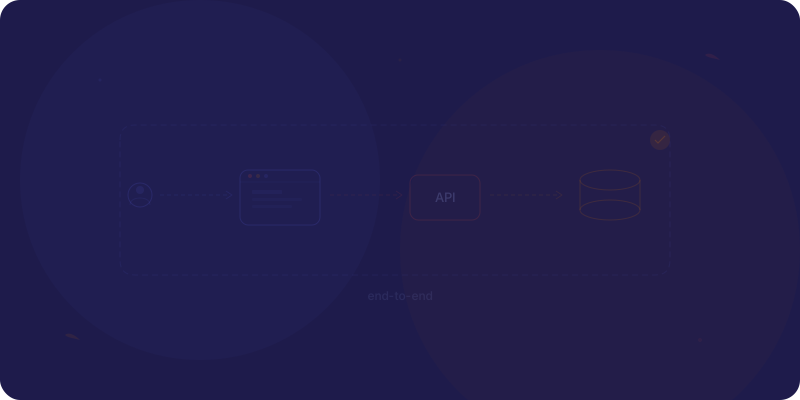
End-to-end testing occupies a paradoxical position in most engineering organizations. Leadership agrees it is essential. Engineers have strong opinions about implementation. Yet the operational reality in the majority of codebases is either a bloated, flaky suite that no one trusts, or a handful of tests that have not been updated in months. The optimal middle ground, a small, reliable set of E2E tests that genuinely protect the product, is achieved by fewer than 25% of engineering teams according to industry surveys.
This analysis focuses on finding that middle ground. Not the theory of E2E testing, but the practical architectural decisions that determine whether a test suite becomes an asset or a liability.
Defining E2E Testing in Operational Context
End-to-end testing validates the complete user journey from initiation to completion. Not a single function in isolation. Not two services communicating with each other. The full flow, as a real user would experience it. Open the browser, authenticate, navigate to a page, perform an action, verify the result.
This is fundamentally different from unit tests and integration tests, and the distinction has significant operational implications. A unit test verifies that a discount calculation function returns the correct value. An integration test verifies that the function communicates correctly with the database. An E2E test verifies that when a customer applies a coupon code at checkout, the price actually changes on the screen and the order processes at the discounted amount.
That final verification, what the user actually sees and experiences, is what makes E2E tests uniquely valuable. They identify defects that exist in the seams between components, in the timing of network requests, in the state management that connects multiple parts of an application. These are the defects that pass through every other layer of testing and surface in production when a real user attempts an operation that should be straightforward.
Failure Mode Analysis: Why Engineering Teams Struggle with E2E
If E2E tests provide such high value, why do most engineering teams have a dysfunctional relationship with them? The answer is that E2E tests are slow, non-deterministic, and expensive to maintain. And teams almost always miscalibrate the balance.
The classic testing pyramid, many unit tests at the base, fewer integration tests in the middle, a thin layer of E2E tests at the top, exists for sound engineering reasons. E2E tests are the most expensive to author, the slowest to execute, and the most likely to fail for reasons unrelated to actual code changes. A network interruption. A slow CI machine. A third-party service experiencing degraded performance. Any of these can turn a passing test into a failure without a single line of application code changing.
Many engineering teams invert the pyramid. They author hundreds of E2E tests because they are the most intuitive to conceptualize, they literally describe user actions. The result is a test suite that takes forty-five minutes to execute, fails intermittently, and requires dedicated engineering capacity to investigate broken tests that consistently turn out to be environmental issues. Data suggests that approximately 35% of E2E test failures in organizations with more than 100 E2E tests are caused by infrastructure rather than code defects.
The opposite failure mode is equally prevalent: engineering teams that have been impacted by flaky E2E tests abandon them entirely. They rely on unit tests and manual QA, and they discover defects in production that a single well-constructed E2E test would have identified. The checkout flow was broken for three days, and no one noticed because the only protection was a unit test that verified the API endpoint returned a 200 status code.
Selection Criteria: Test User Journeys, Not Features
The single most consequential decision in E2E testing is selecting what to test. The answer is more focused than most engineering teams make it: test user journeys, not features.
Engineering teams should not write an E2E test for every form field validation. They should not write one for every error message. They should not write one that checks whether a tooltip appears on hover. Those are unit test and integration test concerns. E2E tests should cover the critical paths, the journeys that, if broken, mean the business is losing revenue or users immediately.
For most applications, the critical paths are remarkably few:
- ●A new user signs up and completes onboarding
- ●A user authenticates, locates a product, and completes a purchase
- ●A user invites a team member and that member gains appropriate access
- ●A user creates content, persists it, and can retrieve it subsequently
- ●A user updates their payment method or subscription tier
If any of these flows fail, someone in the business is impacted immediately. These are the flows that warrant E2E test coverage. Everything else is better served by faster, more deterministic test types further down the pyramid.
Implementation Patterns for Reliability and Maintainability
Once the critical journeys have been identified, the next challenge is authoring tests that are reliable and maintainable. The following patterns consistently produce positive outcomes across engineering teams and frameworks:
- ●Page Object Model. Abstract selectors and page interactions away from test logic. Instead of writing
await page.click('#submit-btn')throughout test files, create aCheckoutPageclass with asubmitOrder()method. When the UI changes, one file is updated instead of twenty tests. This pattern reduces maintenance overhead by approximately 70%. - ●Data-testid attributes. Engineering teams should not rely on CSS classes, text content, or DOM structure for selectors. These change during normal development. Dedicated
data-testidattributes survive UI refactors, design system updates, and content changes because their sole purpose is test stability. - ●Test isolation. Each test should create its own data, execute independently, and clean up after itself. Tests must never rely on execution order. If test B fails because test A did not run first, the test suite has a design defect, not a test failure.
- ●Parallel execution. Tests should be structured for concurrent execution. This is one of the most effective methods to reduce suite time from forty minutes to five. Isolation makes this achievable. If tests do not share state, they can execute simultaneously without interference.
- ●Condition-based waiting. Engineering teams should never use
sleep(3000)and assume the page has loaded. Tests should always wait for specific conditions: an element appears, a network request completes, a loading indicator disappears. Hard-coded waits are the single largest source of flakiness in E2E suites. They are either too short (test fails on slow infrastructure) or too long (suite takes excessively long to execute).
Failure Triage Protocol
The most significant mistake engineering teams make with E2E tests is not writing too many or too few. It is ignoring them when they fail. A failing E2E test that remains unaddressed for a week is worse than having no test at all, because it trains the entire team to disregard test failures.
Every E2E test failure should be triaged immediately using a classification framework:
Classification: Genuine regression
The test identified a real code defect. This is the test performing its intended function. Resolve the defect, verify the test passes, and document the incident. This is also the appropriate moment to reinforce for the team why E2E tests exist.
Classification: Environmental failure
The test failed because the staging database was down, the CI machine ran out of memory, or a third-party API was unreachable. Resolve the environment issue, re-execute the test, and evaluate whether the test infrastructure requires investment.
Classification: Non-deterministic failure
The test fails intermittently with no code change. This is the most damaging category because it erodes organizational trust in the test suite. If the root cause cannot be identified and resolved within five minutes, the test should be quarantined. Move it to a separate suite, mark it as known-flaky, and schedule dedicated time to investigate. It must not block deployments while it is unreliable.
The discipline of triaging failures rapidly is what distinguishes engineering teams that trust their E2E tests from engineering teams that ignore them. If a test fails and no one investigates for three days, trust has already been lost. The practice of treating every failure as worth understanding, even when the conclusion is “this test is flaky and needs to be quarantined,” is what maintains suite health.
Optimal Suite Size: Quantitative Guidelines
Fewer than most engineering teams expect. This is perhaps the most counterintuitive guidance in testing strategy, but it is consistently validated: a small number of well-constructed E2E tests delivers more value than a large number of brittle ones.
For most web applications, 20 to 30 E2E tests covering the critical user journeys will provide more deployment confidence than 200 tests covering every edge case. Those 200 tests will take an hour to execute, fail unpredictably, and require continuous maintenance. Those 20 tests will execute in minutes, pass deterministically, and provide immediate signal when something critical is broken.
The objective of E2E testing is not coverage percentage. Coverage is a metric for unit tests, and even in that context it is a rough proxy. The objective is deployment confidence: the ability to release on a Friday afternoon with certainty that the critical paths function correctly. That confidence comes from a small suite that the team trusts completely, not a large suite that the team trusts partially.
If an engineering team finds itself maintaining more than fifty E2E tests, it should conduct an honest evaluation: how many of these tests cover behavior that would genuinely cause a user-facing incident if it failed? The remaining tests should be migrated to integration or unit test layers where they belong. The suite will be faster, more reliable, and more operationally useful.
Operational Framework: Sustainable E2E Testing
There is a specific operational state that characterizes well-functioning E2E test suites. It is not excitement. It is the absence of anxiety. The engineering team merges a large refactor and the tests pass. A new feature is deployed and the critical paths are all green. Monday morning arrives and the overnight test run shows nothing unexpected.
That operational confidence is the true output of effective E2E testing. Not a dashboard of green checkmarks. Not a coverage number for a slide deck. Rather, the steady certainty that the capabilities users depend on most are being validated continuously by tests the engineering team trusts to provide accurate signal.
Achieving this state requires restraint more than effort. Author fewer tests, but author them well. Select the critical journeys, not all journeys. Resolve failures immediately, or quarantine them transparently. And maintain focus on the fundamental objective: E2E testing does not exist to prove software is defect-free. It exists to provide engineering teams with justified confidence that the critical capabilities function correctly.